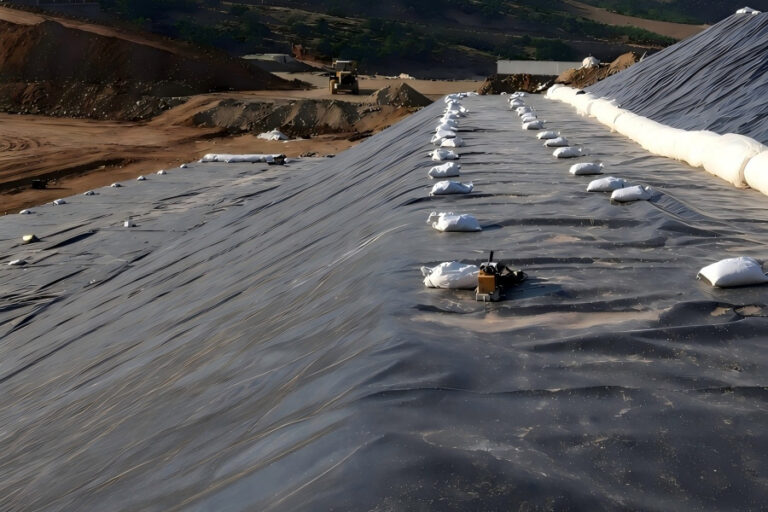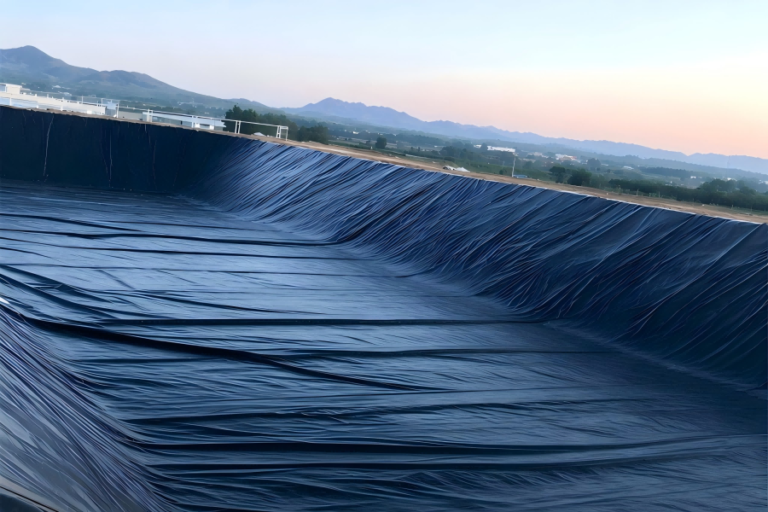

A geomembrane liner is expected to remain effective for years, often under conditions that involve constant moisture, soil pressure, chemical exposure, and temperature changes. In applications such as landfills, mining facilities, wastewater treatment ponds, and water containment projects, even a small loss of liner integrity can affect the performance of the entire containment system.
This is why selecting an HDPE geomembrane involves more than checking its thickness or initial waterproofing capability. Its material properties determine how well it resists environmental stress, maintains its physical structure, and performs throughout its service life. Understanding these properties helps project owners and engineering contractors make more informed decisions when specifying an HDPE geomembrane liner.
1. Low Permeability: The Foundation of Long-Term Seepage Control
The primary function of an HDPE geomembrane is to create a barrier that limits liquid movement through the containment structure. High-density polyethylene has a relatively dense molecular structure, which contributes to its low permeability. This makes HDPE geomembrane a widely used material in projects where seepage control is a major requirement.
However, long-term barrier performance depends on more than the permeability of the material itself. Punctures, poorly executed seams, uneven subgrades, and installation damage can create potential leakage paths. Even a geomembrane with excellent material properties may fail to provide reliable containment if these factors are not properly managed.
For landfill liners, wastewater ponds, and other containment applications, the geomembrane must therefore be considered as part of a complete lining system rather than an isolated waterproofing product.

2. Tensile Strength and Elongation: Handling Ground Movement
Ground conditions can change over time. Soil settlement, uneven loading, and changes in the surrounding structure may place tensile stress on a geomembrane liner. If the material cannot accommodate these stresses, excessive deformation or tearing may compromise the containment layer.
Tensile strength indicates how much pulling force a material can withstand before failure, while elongation at break describes how much it can stretch before breaking. Both are important HDPE geomembrane properties when evaluating suitability for large-scale engineering projects.
A suitable balance between strength and deformation capacity helps the liner withstand mechanical stress during installation and service. Engineers should review actual test results rather than relying on general descriptions such as high strength or flexible performance. The required values should be determined according to project conditions, liner thickness, and applicable technical specifications.
3. Puncture Resistance: Protecting the Liner from Physical Damage
A geomembrane is not always installed over a perfectly smooth surface. Small stones, construction debris, sharp aggregates, and uneven subgrade conditions can create localized pressure points. During backfilling or operation, these points may place concentrated stress on the liner. Puncture resistance is therefore an important consideration, particularly in landfill applications, mining projects, and other installations involving contact with soil or granular materials. A suitable HDPE geomembrane should be evaluated for its resistance to localized mechanical damage. At the same time, material selection cannot replace proper site preparation. The supporting surface should be inspected and prepared before installation, and protective geotextile layers may be considered where the engineering design requires additional cushioning. These measures work together to reduce the risk of damage and help maintain the integrity of the HDPE geomembrane liner.
4. Chemical Resistance: Maintaining Performance in Aggressive Environments
Not every containment project involves clean water. Landfill leachate, industrial wastewater, and mining-related liquids may contain different chemical substances that can affect the materials used in a lining system.
HDPE is valued for its chemical resistance and generally performs well when exposed to many acids, alkalis, and other chemical solutions. This makes HDPE geomembrane suitable for a range of environmental protection and industrial containment applications.
Nevertheless, chemical compatibility should never be assumed for every operating condition. The actual liquid composition, concentration, temperature, and exposure duration all influence material performance. For projects involving unusual or highly concentrated chemicals, engineers should assess compatibility against the expected operating environment and relevant test data.
Choosing the right geomembrane based on actual chemical exposure helps reduce the risk of premature material deterioration.
5. UV Resistance and Oxidative Stability: Important Factors in Outdoor Applications
Some geomembrane liners are covered soon after installation, while others may remain exposed to sunlight during construction or throughout part of their service life. Continuous ultraviolet exposure can contribute to polymer degradation, potentially affecting material properties over time.
Carbon black and appropriate stabilizing additives are commonly used in HDPE geomembrane formulations to improve resistance to UV-related degradation. However, the actual weathering performance depends on the formulation, additive quality, manufacturing control, and exposure conditions.
Oxidative stability is another factor worth considering when evaluating long-term performance. Antioxidants help protect the polymer against oxidation, which can occur during processing and long-term exposure to environmental conditions. For outdoor projects, buyers should pay attention to relevant UV and oxidative aging test results. These provide a more useful basis for comparison than general claims about long service life.

6. Thickness and Manufacturing Consistency: Keeping Performance Reliable
Geomembrane thickness affects several aspects of liner performance, including mechanical protection, puncture resistance, and the ability to accommodate installation conditions. A thicker liner may offer advantages in certain demanding applications, but thickness alone does not guarantee better overall performance.
The selected thickness should match the project design, subgrade conditions, installation method, and applicable engineering standards. For example, a landfill liner may have different technical requirements from a decorative artificial lake or an agricultural pond.
Manufacturing consistency is equally important. Variations in thickness, surface quality, and material composition can lead to inconsistent performance across a roll or production batch. Buyers should review product specifications, quality inspection records, and relevant test reports before confirming an order.
7. Installation Quality Determines How Well the Material Performs
Even a well-manufactured HDPE geomembrane can be compromised by poor installation. Improper welding, insufficient seam inspection, careless handling, or damage from construction equipment may create weak points in the containment system.
Before installation, the subgrade should be properly prepared and free from sharp objects that could damage the liner. During deployment, panels should be positioned and handled according to the installation plan. Welding parameters and seam quality also require careful control, with appropriate testing carried out to verify joint integrity. For engineering contractors and project owners, it is important to consider material specifications and installation procedures together. Long-term liner performance depends on both.
Choosing HDPE Geomembrane for Long-Term Engineering Applications
Selecting an HDPE geomembrane is a technical decision that should be based on the actual conditions of the project. Low permeability supports seepage control, tensile and puncture resistance help the liner withstand mechanical stress, and chemical and UV resistance contribute to durability under different environmental conditions.
For buyers evaluating an HDPE geomembrane manufacturer, key considerations include product thickness, material specifications, mechanical test results, aging performance, manufacturing consistency, and quality documentation. These details help determine whether a product is suitable for a particular containment application.
Jiantong focuses on geomembrane products for engineering and environmental protection applications. By paying attention to raw material inspection, production thickness control, and finished-product testing, Jiantong supports buyers in evaluating HDPE geomembrane quality against project requirements. For landfill, mining, water containment, and other lining projects, matching material properties with site conditions is an essential step toward maintaining reliable long-term performance.