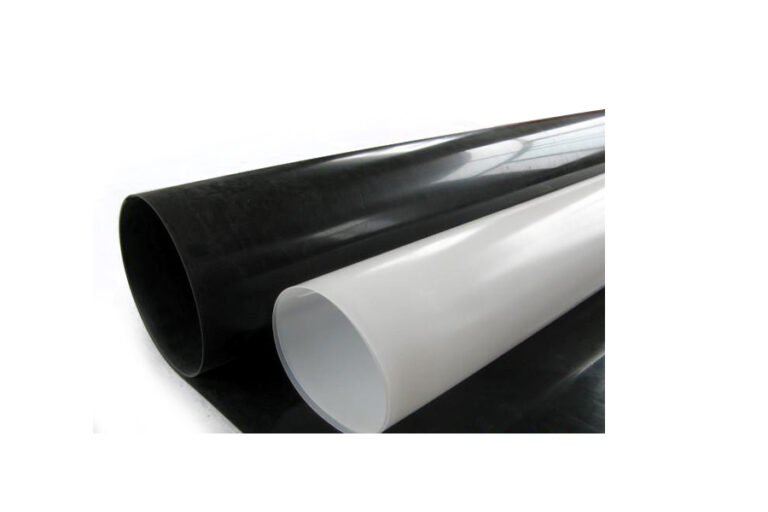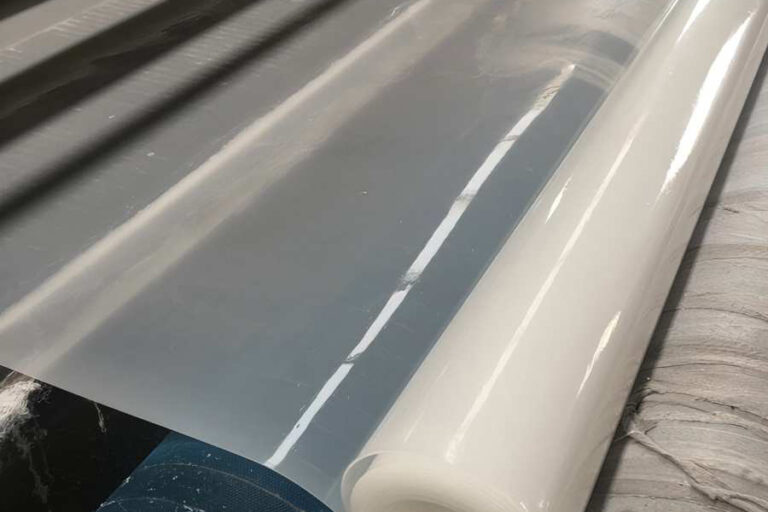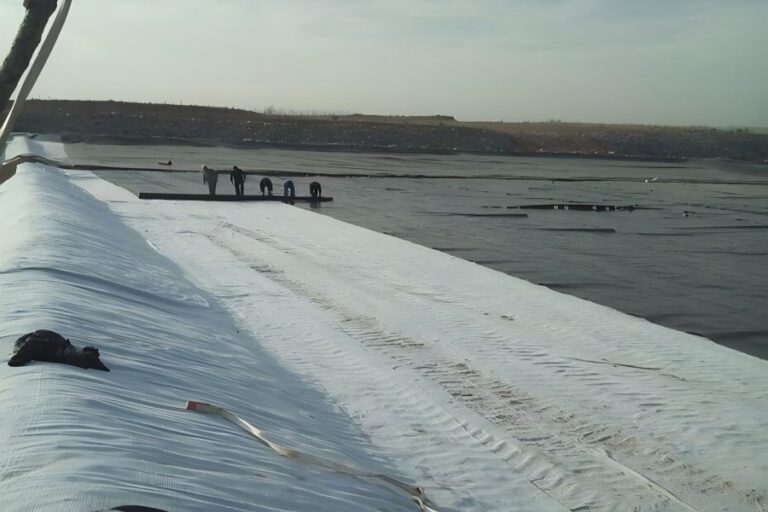

Inside Jiantong’s production workshop, the HDPE geomembrane production line runs continuously. High-density polyethylene (HDPE) resin enters the extrusion process, where heat and pressure transform it into a continuous sheet. The equipment then cools the sheet and winds it into finished rolls. Meanwhile, technicians collect samples and check their properties in the testing laboratory.
For an experienced HDPE geomembrane manufacturer, production involves much more than making a sheet of plastic. The real challenge lies in ensuring that every roll meets the technical requirements of its intended application.
Landfills, tailings storage facilities, reservoirs, and wastewater treatment plants all rely on effective containment systems. An HDPE geomembrane liner helps prevent unwanted liquid migration and protects the surrounding environment. However, inconsistent thickness, poor mechanical strength, or inadequate durability can create costly problems during installation and operation.
That is why HDPE geomembrane quality testing plays such an important role in manufacturing. At Jiantong, quality control covers raw material selection, production monitoring, laboratory testing, and final inspection. Each step helps buyers assess product quality before shipment.
1. Why Does HDPE Geomembrane Quality Control Start with Raw Materials?
The quality of an HDPE geomembrane begins with the polyethylene resin. Although two geomembranes may look almost identical, differences in resin grade and material consistency can affect their processing characteristics and final performance.
Some buyers focus heavily on the purchase price. However, choosing an unsuitable resin simply to reduce costs may introduce greater variation in mechanical properties and long-term durability. For projects that depend on reliable leakage prevention, this decision can create unnecessary risks.
A professional HDPE geomembrane manufacturer checks incoming materials before production begins. Technicians review resin grades, material specifications, and relevant processing characteristics against established requirements. They may also use melt flow rate testing to evaluate whether the resin suits the intended extrusion process.
These checks help manufacturers maintain stable production conditions and consistent product quality.
When comparing an HDPE geomembrane supplier, buyers should ask how the company verifies incoming materials. They should also check whether the supplier maintains inspection records for individual production batches. Reliable quality control starts with the materials that enter the factory, not just the finished rolls.

2. How Do Manufacturers Control Geomembrane Thickness?
After the raw materials pass inspection, the production team focuses on extrusion stability and dimensional consistency.
During extrusion, the equipment melts polyethylene resin and forms it into a continuous geomembrane sheet. Temperature, extrusion speed, cooling conditions, and equipment performance all influence the final product. Manufacturers must monitor these variables throughout the production run.
Thickness remains one of the most important specifications for an HDPE geomembrane liner. A roll may carry the correct nominal thickness, yet local variations can still affect its consistency. Thin areas may face greater stress when the liner rests on uneven ground or encounters sharp particles.
Manufacturers use production monitoring and dimensional checks to identify these variations. When measurements fall outside the required tolerances, the production team can investigate the cause and adjust the process.
Jiantong focuses on manufacturing control to help maintain consistent geomembrane dimensions. Buyers should review thickness measurements and applicable tolerances before accepting a shipment.
Roll width and length also deserve attention. The right dimensions can reduce the number of field seams required for a particular site layout. Fewer seams may simplify installation and reduce the number of joints that require welding and inspection.
However, the ideal roll size depends on the engineering design, site access, and installation plan. Buyers should confirm these details with their project teams before placing an order.
When evaluating HDPE geomembrane quality, check three key details: thickness, dimensional tolerances, and the manufacturer’s inspection procedures. These specifications help confirm whether the material matches the project’s requirements.
3. What Laboratory Tests Does an HDPE Geomembrane Need?
A geomembrane may look smooth and uniform on the production line. However, appearance alone cannot reveal its mechanical properties. Laboratory testing provides more useful evidence of material performance.
Depending on the applicable standards and project specifications, HDPE geomembrane testing may cover tensile strength, elongation at break, puncture resistance, and other relevant indicators. Each test examines a different property and helps determine whether the product meets the required acceptance criteria.
Tensile Strength and Elongation at Break
Tensile testing measures how a geomembrane responds to a controlled pulling force. The test helps evaluate its resistance to stretching forces under specified conditions.
Elongation at break measures how far the specimen stretches before it fails. Together, these results help buyers understand the material’s mechanical behavior. They also provide useful information when engineers assess potential stress during handling, installation, and service.
Project teams should compare the test results with the values required by the relevant material standard or technical specification.
Puncture Resistance
Construction sites rarely offer perfectly smooth conditions. Aggregate, uneven subgrades, and other materials can create concentrated pressure beneath a geomembrane.
Puncture resistance testing evaluates how the material responds to a defined loading condition. This information helps engineers assess whether the selected geomembrane suits the installation environment.
However, puncture resistance alone cannot guarantee protection against every site hazard. Proper subgrade preparation, suitable protective layers, and careful installation remain essential.
Barrier Performance and Leakage Prevention
An HDPE geomembrane provides a low-permeability barrier for containment applications. Landfills, wastewater treatment facilities, and water storage projects depend on this property to control liquid migration.
Buyers should verify that the material meets the applicable permeability and quality requirements. They should also distinguish between the performance of the geomembrane sheet and the integrity of the complete liner system.
Even a high-quality geomembrane can develop leakage paths if installers make poor welds or damage the material during construction. Factory testing and field seam inspection therefore serve different but equally important purposes.
A reliable HDPE geomembrane manufacturer should explain the tests required for each product, identify the relevant standards, and clarify how technicians evaluate the results.

4. How Do Manufacturers Evaluate Long-Term Durability?
Many containment projects require an HDPE geomembrane to perform for decades. Initial mechanical strength matters, but long-term durability deserves equal attention.
Depending on the application, a geomembrane may face ultraviolet (UV) radiation, temperature changes, chemical exposure, and oxidation. These conditions can gradually affect material properties over time.
Manufacturers use suitable formulations to improve resistance to environmental degradation. Carbon black, for example, helps protect HDPE geomembranes against UV exposure. Appropriate stabilizing additives can also support resistance to oxidative degradation.
The effectiveness of these materials depends on the formulation, processing conditions, and compliance with relevant product requirements.
Depending on the project specification, durability-related testing may include:
- Carbon black content: Evaluates the proportion of carbon black in the material.
- Carbon black dispersion: Examines how evenly the carbon black distributes throughout the polymer.
- Oxidative induction time (OIT): Assesses oxidative stability under defined laboratory conditions.
- Accelerated aging tests: Evaluate material behavior after controlled exposure to specified environmental conditions.
These tests provide valuable information about material quality. However, they cannot guarantee an exact service life under every field condition.
For buyers sourcing an HDPE geomembrane for environmental protection, the key is to match documented properties to the actual operating environment. A landfill liner, mining containment system, and water storage facility may require different performance characteristics.
Jiantong can discuss product specifications with buyers according to their application requirements. Clear technical discussions before ordering help both parties identify the appropriate material and avoid unnecessary specification mismatches.
5. What Should Buyers Check in an HDPE Geomembrane Test Report?
Laboratory results become more useful when buyers can connect them to the actual product they receive. A supplier’s verbal assurance cannot replace clear technical documentation.
When evaluating an HDPE geomembrane supplier, buyers should review the available quality records. Depending on the purchase agreement and project requirements, these documents may include:
- Product specifications and nominal thickness
- Roll dimensions and dimensional tolerances
- Applicable testing standards
- Relevant mechanical and durability test results
- Production batch identification
- Quality certificates or inspection reports
- Independent third-party test reports, where required
These records help project teams compare the delivered material with the original order. They also provide supporting evidence for construction quality management and project acceptance.
For projects with strict inspection requirements, buyers should agree on the testing scope and acceptance criteria before production or shipment. This step helps prevent disputes over specifications after the material arrives.
When comparing different HDPE geomembrane manufacturers, look beyond the quoted price. Ask each supplier to explain its quality control procedures and provide documentation that addresses your project’s actual requirements.
At Jiantong, quality control supports product consistency and helps buyers evaluate whether the supplied geomembrane meets their technical specifications. Clear documentation also makes communication between suppliers, contractors, and project owners more straightforward.

6. Does Factory Testing Guarantee Good Performance After Installation?
Factory inspection plays a critical role in product quality, but it cannot guarantee the performance of an entire containment system. Installation conditions also affect the final result.
Poor subgrade preparation, careless material handling, unsuitable welding conditions, and inadequate seam inspection can compromise a liner system. These problems may occur even when the geomembrane meets the required factory specifications.
Project teams should therefore coordinate material selection with construction planning. Before purchasing an HDPE geomembrane liner, confirm the following details:
- Required thickness: Match the material to the engineering design and project specifications.
- Roll dimensions: Choose practical dimensions for site conditions and seam layout.
- Performance requirements: Identify the mechanical, chemical, and durability properties that the application demands.
- Installation conditions: Evaluate the subgrade, protective layers, and expected environmental exposure.
- Seam quality control: Establish suitable welding procedures and inspection methods for field joints.
These checks help reduce installation risks and improve coordination between procurement and construction teams.
Jiantong provides HDPE geomembrane solutions for a range of engineering applications. Buyers can discuss material specifications and project requirements with the company before finalizing their orders. Where included in the agreed service scope, technical support can also help clarify product selection and installation considerations.
For international buyers, working with an experienced HDPE geomembrane manufacturer and supplier can simplify technical discussions, product selection, and delivery coordination. The goal is to choose a material that meets the design requirements and integrates properly into the complete containment system.
7. How Can You Choose the Right HDPE Geomembrane Manufacturer?
Choosing an HDPE geomembrane manufacturer requires more than comparing quotations. Buyers should examine the company’s raw material controls, production consistency, laboratory testing procedures, and product documentation.
A dependable supplier should explain how it manufactures the geomembrane and which technical specifications the product meets. Buyers should also confirm that the testing methods and acceptance criteria match the project documents.
This process becomes especially important for landfills, mining facilities, wastewater treatment plants, and other applications where containment performance is critical.
At Jiantong, attention to manufacturing quality and project requirements supports the supply of HDPE geomembranes for different engineering applications. By confirming specifications before ordering and reviewing quality records before shipment, buyers can reduce the risk of receiving material that does not match their needs.
A finished geomembrane roll may appear simple, but its reliability depends on many decisions throughout production. Resin selection, thickness control, laboratory testing, and final inspection all contribute to the quality of the material delivered to the construction site.
Before your next project, visit Jiantong to learn more about its HDPE geomembrane products and discuss the specifications for your containment application. A clear understanding of material requirements and quality documentation will help you make a more informed purchasing decision.